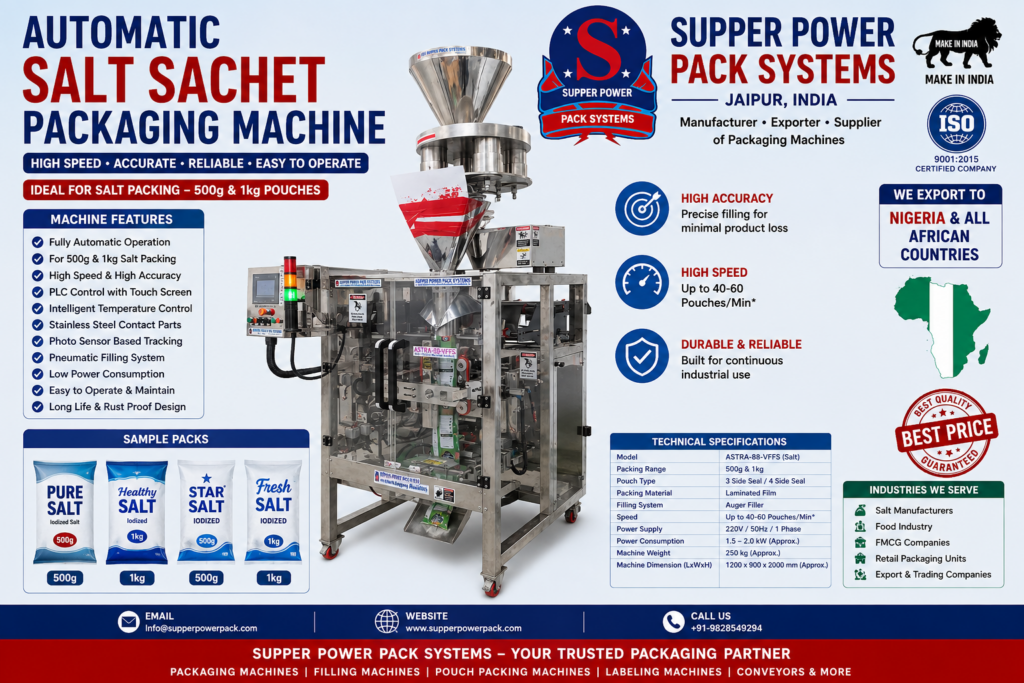
The demand for hygienically packed salt is increasing across Nigeria, driven by the growth of supermarkets, wholesalers, food processors, restaurants, hotels, institutional buyers, and FMCG companies. For manufacturers and distributors looking to improve production efficiency, an automatic salt sachet packaging machine can provide accurate filling, consistent pouch quality, improved hygiene, and reduced manual labor.
SUPPER POWER PACK SYSTEMS, Jaipur, India, manufactures and exports packaging machinery designed for a wide range of granular and free-flowing products, including edible salt. The company’s salt sachet packaging solutions can be considered by Nigerian FMCG companies looking for an efficient and scalable way to pack salt into small consumer sachets.
Salt Sachet Packaging Machine for Nigeria
A salt sachet packaging machine is an automatic packaging system designed to measure, fill, form, seal, and cut individual sachets of salt. Depending on the machine configuration, it can be used for different pouch sizes and production requirements.
For Nigerian FMCG companies, automatic sachet packaging is particularly useful where high production volumes, consistent pack weights, attractive packaging, and hygienic handling are important.
The machine can be integrated into a complete packaging line with product storage, feeding, dosing, pouch forming, sealing, date coding, counting, collection, and secondary packaging.
SUPPER POWER PACK SYSTEMS provides packaging machinery from its manufacturing base in Jaipur, India, for domestic and export applications.
Why Nigerian FMCG Companies Need Automatic Salt Packaging
Salt is a high-volume FMCG product. Although the product itself is relatively simple, commercial packaging requires consistency and speed.
Manual salt filling can create several production problems:
- Inconsistent filling weights
- Higher dependence on manual labor
- Product spillage
- Slow production
- Poor pouch consistency
- Increased handling of food products
- Difficulty maintaining production records
- Higher packaging labor costs
- Inconsistent sealing
- Difficulty scaling production
An automatic salt sachet packing machine addresses many of these challenges by automating the principal packaging operations.
The machine can continuously feed salt into the dosing system, accurately measure the required quantity, form the packaging film into a pouch, fill the measured salt, seal the pouch, and cut the finished sachet.
Automatic Salt Sachet Packing Process
A typical automatic salt sachet packaging line follows a controlled sequence:
1. Salt Feeding
Prepared edible salt is supplied to the machine’s product hopper. The feeding system transfers salt toward the dosing mechanism.
The salt should be properly prepared and suitable for automatic dosing. Excessive moisture, irregular particles, or foreign material can affect machine performance.
2. Dosing and Measuring
The dosing system measures the required quantity of salt for every sachet.
Depending on the machine design and required application, suitable volumetric or other dosing arrangements can be selected.
The objective is to maintain consistent product quantity from sachet to sachet.
3. Film Feeding
Packaging film is installed on the film roll holder. The machine automatically pulls the film through the forming and sealing section.
Film tracking and controlled feeding help maintain consistent pouch dimensions.
4. Pouch Forming
The packaging film passes through the forming section and is shaped into the required sachet format.
The forming arrangement can be selected according to the desired pouch size and packaging material.
5. Salt Filling
The measured salt is discharged into the formed pouch.
The controlled filling operation helps reduce product loss and improves consistency compared with manual filling.
6. Heat Sealing
The filled pouch passes through the sealing section, where the packaging material is sealed.
Good sealing is essential for maintaining product protection, preventing leakage, and producing commercially attractive sachets.
7. Cutting
After sealing, individual sachets are cut from the continuous film.
The finished sachets can then be collected manually or transferred to a conveyor or secondary packaging system.
Salt Sachet Packing Machine Applications
Automatic salt sachet packaging machinery can be used for various salt products and related FMCG applications.
Typical applications include:
- Edible salt
- Table salt
- Iodized salt
- Fine salt
- Granulated salt
- Refined salt
- Food-grade salt
- Household salt
- Retail salt sachets
- Institutional salt packs
The exact machine configuration should be selected according to the salt particle characteristics, desired pack size, film type, production capacity, and packaging format.
Small Salt Sachets for Nigerian Retail Markets
Small sachets are important for FMCG distribution because they can make products accessible to consumers purchasing according to their daily or weekly budgets.
For salt manufacturers, sachet packaging can support distribution through:
- Local retail shops
- Supermarkets
- Open markets
- Wholesalers
- Food-service businesses
- Hotels
- Restaurants
- Caterers
- Institutional buyers
- Distributors
A well-designed sachet provides a convenient unit of sale while helping manufacturers standardize their product presentation.
Different Salt Packaging Sizes
The required pouch size depends on the target market and product positioning.
Salt packaging machines can be configured for different pack weights and dimensions according to the customer’s requirements.
Common commercial concepts include:
- Small single-use sachets
- Household retail sachets
- Medium consumer packs
- Larger institutional packs
The exact filling range, pouch dimensions, machine speed, film width, and dosing system should be finalized according to the required specification.
Features to Consider When Buying a Salt Sachet Packaging Machine
Nigerian FMCG companies should evaluate several technical factors before purchasing a packaging machine.
Automatic Operation
Automatic operation reduces repetitive manual work and allows the machine to perform feeding, dosing, forming, sealing, and cutting in a controlled sequence.
Accurate Filling
Filling accuracy is important because underweight packs can create commercial problems, while excessive filling can increase product giveaway.
Strong Sealing
The sealing system should be appropriate for the selected packaging film and salt application.
Easy Machine Operation
An operator-friendly control system helps production personnel adjust machine parameters and monitor operation.
Stainless-Steel Product Contact Parts
For food applications, stainless-steel product-contact construction is an important consideration for hygiene, cleaning, and durability.
Compact Design
A compact machine can be advantageous for FMCG manufacturers where production-floor space is limited.
Easy Cleaning and Maintenance
Salt can accumulate around product-contact and machine areas. A packaging machine should therefore be designed for practical cleaning and routine maintenance.
Reliable Film Feeding
Consistent film feeding helps maintain pouch dimensions and sealing quality.
Packaging Materials for Salt Sachets
Salt can be packed using suitable flexible packaging films selected according to the required barrier properties, sealability, appearance, and intended shelf life.
The final packaging material should be compatible with:
- Product characteristics
- Machine sealing temperature
- Film thickness
- Film structure
- Printing requirements
- Storage conditions
- Distribution conditions
- Desired pouch appearance
Before commercial production, the selected film should be tested on the actual machine to verify forming, sealing, cutting, and overall pack quality.
Complete Salt Packaging Line
For larger Nigerian FMCG manufacturers, a standalone sachet machine may be only one part of the overall production and packaging operation.
A more complete system can include:
Salt Preparation → Storage Hopper → Feeding System → Dosing System → Sachet Packing Machine → Date Coding → Conveyor → Counting/Collection → Secondary Packaging
Secondary packaging can then be used to group individual sachets into larger transport or wholesale packs.
This approach can help manufacturers move toward a more organized end-to-end packaging operation.
Secondary Packaging of Salt Sachets
After individual sachets are produced, FMCG companies may need to collect and group them into larger bags or cartons.
Secondary packaging can improve:
- Product handling
- Warehouse organization
- Transportation
- Distributor handling
- Counting
- Bulk shipment preparation
For high-volume operations, the primary sachet machine can therefore be integrated with conveyors and secondary packaging equipment.
Benefits of Automatic Salt Sachet Packaging for Nigerian FMCG Manufacturers
1. Higher Production Efficiency
Automation allows continuous packaging operations and reduces dependence on manual filling.
2. Better Product Consistency
Controlled dosing and sealing help maintain consistent pack presentation.
3. Reduced Product Wastage
Accurate dosing can reduce unnecessary product giveaway and spillage.
4. Improved Hygiene
Automated handling can reduce direct human contact with the product during packaging.
5. Better Packaging Appearance
Uniform pouch dimensions and sealing can provide a more professional retail presentation.
6. Easier Production Scaling
A properly selected automatic machine can support growing production requirements.
7. Reduced Repetitive Labor
Automation minimizes repetitive filling and sealing tasks.
8. Better Brand Presentation
Printed packaging film can be used to display the manufacturer’s brand, product information, regulatory information, and other required details.
Salt Sachet Packaging Machine for Startups and Established FMCG Companies
The machine requirements of a startup can be different from those of an established salt manufacturer.
A startup may prioritize:
- Lower initial investment
- Compact equipment
- Simple operation
- Flexible pack sizes
- Easy maintenance
- Future expansion
A larger FMCG company may prioritize:
- Higher production capacity
- Automatic feeding
- Multiple packaging stages
- Continuous operation
- Integration with conveyors
- Secondary packaging
- Production monitoring
- Multiple packaging formats
For this reason, machinery should be selected based on actual production requirements rather than simply choosing the highest-speed machine available.
How to Select the Right Salt Sachet Packing Machine in Nigeria
Before ordering equipment, Nigerian buyers should prepare a technical requirement covering the following points:
- Product name
- Product grade
- Salt particle size
- Moisture characteristics
- Required sachet weight
- Required sachet dimensions
- Desired production capacity
- Packaging film specification
- Electrical supply requirements
- Installation location
- Available floor space
- Operator requirements
- Date coding requirements
- Secondary packaging requirements
- Future production expansion
Providing this information to the manufacturer allows the machine configuration to be matched more accurately to the application.
Why Work With an Indian Packaging Machine Manufacturer?
India has a large manufacturing ecosystem for food and FMCG packaging machinery. Nigerian businesses can source packaging equipment from Indian manufacturers for applications ranging from powder and granule packaging to liquid, snack, and secondary packaging.
Working directly with a manufacturer can provide advantages such as:
- Technical consultation
- Machine customization
- Factory testing
- Spare parts support
- Installation guidance
- Operator training
- Packaging trials
- Export documentation
- Long-term technical assistance
For Nigerian buyers, the most important consideration should be the manufacturer’s ability to understand the product, packaging material, production requirement, and local operating conditions.
SUPPER POWER PACK SYSTEMS – Manufacturer & Exporter from Jaipur, India
SUPPER POWER PACK SYSTEMS, Jaipur, India, manufactures and exports packaging machinery for food and FMCG applications.
The company can provide packaging solutions for different product categories, including granular, powder, snack, and other products requiring automatic filling and packaging.
For salt manufacturers and Nigerian FMCG companies, the company can be approached for an automatic salt sachet packaging machine based on the required pack size, packaging material, production capacity, and machine configuration.
The final machine specification should be confirmed through technical discussion and product/film trials before purchase.
Exporting Salt Packaging Machines from India to Nigeria
For an international packaging machinery purchase, Nigerian buyers should consider the complete supply chain rather than only the machine price.
Important considerations include:
- Machine configuration
- Production capacity
- Packaging material compatibility
- Electrical specifications
- Spare parts
- Documentation
- Export packing
- Shipping arrangements
- Installation
- Commissioning
- Operator training
- After-sales technical support
The exporter and buyer should agree on commercial terms, shipping responsibilities, documentation, installation requirements, and technical specifications before placing the purchase order.
Installation and Commissioning in Nigeria
Proper installation is essential for achieving the expected performance of an automatic salt sachet packaging machine.
Before installation, the buyer should prepare:
- Suitable machine floor space
- Stable electrical supply
- Appropriate environmental conditions
- Product storage arrangements
- Packaging film
- Salt product for testing
- Operators
- Maintenance personnel
- Required tools and utilities
Machine commissioning should include checking film movement, pouch formation, dosing, sealing, cutting, coding, and finished-pack quality.
Operators should also be trained in machine operation, cleaning, routine inspection, and basic troubleshooting.
Maintenance of Salt Sachet Packaging Machines
Routine maintenance helps maintain reliable production.
A maintenance program should include:
- Cleaning product-contact areas
- Checking sealing components
- Inspecting film-feeding components
- Checking sensors
- Inspecting electrical connections
- Lubricating applicable mechanical components
- Checking fasteners
- Inspecting cutting components
- Cleaning dust and salt accumulation
- Checking dosing components
Preventive maintenance is generally preferable to waiting until a machine breakdown stops production.
Common Problems and Troubleshooting
Uneven Sachet Weight
Possible causes include inconsistent product flow, incorrect dosing settings, product characteristics, or improper machine adjustment.
Poor Sealing
Possible causes include unsuitable film, incorrect sealing temperature, pressure problems, contamination in the sealing area, or incorrect settings.
Film Tracking Problems
Film alignment, roll installation, tension, or forming adjustments may need to be checked.
Product Leakage
Leakage may result from poor sealing, product trapped in the seal area, inappropriate film, or incorrect sealing parameters.
Machine Stoppage
Sensors, electrical connections, safety systems, mechanical components, or incorrect machine settings should be checked according to the manufacturer’s troubleshooting procedure.
Quality Control for Packed Salt
A commercial salt packaging operation should establish quality checks for both the product and finished package.
Important checks may include:
- Pack weight
- Seal integrity
- Sachet dimensions
- Print quality
- Date coding
- Packaging appearance
- Leakage
- Film defects
- Product contamination
- Batch traceability
Regular quality control helps ensure that finished sachets meet the manufacturer’s internal standards and applicable market requirements.
Frequently Asked Questions
What is a salt sachet packaging machine?
A salt sachet packaging machine is an automatic packaging machine that measures salt, forms flexible packaging film into sachets, fills the measured product, seals the pouch, and cuts individual packs.
Can the machine pack iodized salt?
Yes, an appropriately configured packaging machine can be designed for suitable free-flowing salt products, including iodized salt. The product should be tested with the selected dosing system before finalizing the machine.
Can Nigerian companies import the machine from India?
Yes. Packaging machinery can be exported from India to international markets. Nigerian buyers should discuss the required machine specification, commercial terms, shipping, installation, and technical support directly with the exporter.
Can different sachet sizes be produced?
Depending on the machine design, different pouch sizes and filling ranges can be accommodated. The required sizes should be specified before manufacturing.
Is automatic salt packing better than manual packing?
For higher-volume FMCG operations, automatic packaging generally offers better consistency, productivity, and process control than manual filling and sealing.
Can the machine be integrated with secondary packaging?
Yes. A salt sachet packaging machine can be incorporated into a broader packaging line using conveyors, counting systems, collection systems, and secondary packaging equipment.
What information should a Nigerian buyer provide to the manufacturer?
The buyer should provide the salt type, required pack weight, pouch dimensions, desired production capacity, packaging film specification, electrical requirements, and intended packaging format.
Conclusion
The growth of FMCG distribution in Nigeria creates opportunities for salt manufacturers to improve their packaging operations with reliable automatic machinery. A salt sachet packaging machine can help manufacturers achieve consistent filling, hygienic handling, uniform sealing, improved productivity, and professional retail packaging.
For Nigerian FMCG companies planning a new salt packaging line or upgrading an existing operation, the correct machine should be selected according to product characteristics, pack sizes, film specifications, production targets, available space, and future expansion plans.
SUPPER POWER PACK SYSTEMS, Jaipur, India, offers packaging machinery for food and FMCG applications and can be contacted by Nigerian businesses seeking an automatic salt sachet packaging solution.
Manufacturer & Exporter
Primary SEO Keywords
- Salt Sachet Packaging Machine for Nigerian FMCG Companies
- Salt Sachet Packing Machine Nigeria
- Automatic Salt Packaging Machine Nigeria
- Salt Packing Machine Manufacturer India
- Salt Sachet Packing Machine Manufacturer
- Salt Packaging Machine Exporter India
- Automatic Salt Sachet Machine
- Salt Sachet Filling and Sealing Machine
- Salt Packing Machine for FMCG
- Salt Packaging Machine for Nigeria
- Edible Salt Sachet Packing Machine
- Iodized Salt Packaging Machine
- Automatic Salt Filling Machine
- Salt Sachet Machine Manufacturer India
- FMCG Packaging Machine Nigeria
- Salt Packing Machine Exporter to Nigeria
- Sachet Packaging Machine Nigeria
- Automatic Sachet Packing Machine Manufacturer India
- Food Packaging Machine for Nigeria
- SUPPER POWER PACK SYSTEMS Jaipur India